Tuesday, 17 April 2012

Switched on living

Mobile communications and ready access to internet on the suite of avaiable devices (smart phones, iPads, iPods) means that people are always "switched on".  There's less downtime now than there was in previous generations and even when on holidays you don't escape contact from others.  This means, generally speaking, that there is less time for contemplation and a reduced ability to make conscious decisions.  People are cramming more into their already busy days.  There's no time for slow cooking, whole foods or smelling the roses. 
Being back in the city has made me aware of how plugged in everyone is.  Recently a news article featured footage of a man walking towards a black bear while texting

On public transport there's no eye contact, no turning of newspaper pages, no conversation.  Instead there's the flurried sweeping of hands across sensory glass screens as people text or flick through tunes to select the song to blare direct into their ears or catch up on e-mail before getting to the office.   What would our grandparents say?  Would they see the folly of our actions and warn us against online networks in favour of interactions with real people? Would they reminisce about the old days when it took 2 weeks to get a letter to a friend in London and another 2 to get a reply?  Would they tell cautionary tales of thinking things through before instantly sending a witty retort that could be incorrectly construed as an insult because in text there is no ability to judge tone?

The recent (admittedly hilarious) viral e-mails about autocorrection fails highlight to me that people aren't even taking the time to proofread their truncated texts before they press the send button.  My mum recently sent me a text telling me that my cousing was "really looking forward to sodding time with me".  Apple clearly has a way to go when they convert spending to sodding.  I don't want to sod time with anyone, thank you!  I get enough sod at the block on weekends.

And don't even get me started on "textese".

People are now experiencing mobile phone addiction (which is surely more of an issue than with televisions and computers as most people don't slip a TV or PC into their bra when they go out for a night with the girls) and there's even a defined mental health condition Facebook addiction disorder

There's also the cost associated with mobile phone use.  With mobile phone users spending on average $140 per month they're racking up over $1600 a year in bills.  Alternatively, this is a new (small) car or a 5% deposit for a home in a decade.

Don't get me wrong, I think social media has it's place and serves to connect people that are geographically isolated.  I am on Facebook and LinkedIn and love to hear what my friends and colleagues are up to.  I love the instant sharing of information, the ease of communicating with people on the other side of the world and the feeling of connectedness that comes with sharing your life with others.

I see kids texting on their way to the station in the morning and during the day on the school holidays.  I happened to chat to a teenage girl recently while waiting at a level crossing and asked her who she was texting so furiously with her fingers flying over the screen of her iPhone, she didn't look up but pointed at the girl next to her and said "her".  When I responded in dismay, "why don't you just talk to her?" the exasperated reply was "I get free text on my plan".  And there you have it; the exact reason I question the mobile life is the apparent rejection of actual interaction with an actual person that you are actually with in favour for communicating via a device that may or may not contribute to brain tumours and comes at a huge cost to individuals and the planet in terms of resources.

As my grandmother would say "What has the world come to?"

Monday, 16 April 2012

Self-sufficiency as a protection mechanism

In reading about recent company closures,  personal bankruptcy and multiple  companies reducing staff numbers, I have been thinking about the role self-sufficiency plays in recession-proofing individuals against the failing economy.

I am well aware of the risks posed to Australia as a society with regards to the looming GFC2.  Hell, when Goldman Sachs are slashing remuneration for senior execs, that's a sure-fire sign that the economic world is going down.

However, I wonder how many have considered the possibility of a perfect storm event.  As witnessed in 2008, the global financial situation has an effect  on the Australian job market, housing affordability and food prices.  Add into the equation climate change, global warming and peak oil and then consider the effects of population growth; what are the ramifications for individuals?  Australians  scraped through the 2008 economic crisis due to the booming resource industry and the fact that China was still manufacturing at full speed when America hit the wall as a result of overextended mortgages.

My take on the 2012 situation is that America is still in the doldrums, Europe is slowly spiralling downwards (Greece avoided defaulting in debt in March by sheer technicality, Italy's debt is on the rise  and Spain is the latest to go down in the government debt crisis).  Furthermore, China has reported plans to reduce manufacturing to meet energy reduction targets and stated a reduced reliance on mineral imports in general.  Add to this that Saudi Arabia has cut oil production (which, to me, screams "we can't increase oil production") and I am seriously worried about the future of the world economy.

I worry that these events are building to a perfect storm where peak oil will hit at the same time as countries increase inflation rates in an attempt to address spiraling debt.  The result, I fear, will be further job losses, loan foreclosures and increased poverty.  Governments that currently offer welfare may well reconsider the amount they provide or the criteria around provision.  This will increase reliance on aid from independent organisations.
The gentleman builder and I have been gearing for such events since 2000 when we wed and honeymooned in the Maldives.  On the plane back, my ever optimistic husband said he was glad we had spent such an exorbitant amount of money on our honeymoon to visit a destination he predicted would not be there in 2100.  Now, his cynicism may be a little depressing but it got me thinking and we started making a plan.

We planned to buy a block large enough to run a farm that would see us self-sufficient in terms of food.  The aim was to buy and build a home without a mortgage to ensure the ownership of the property should the economy fail and we risk losing our security blanket to increased interest rates or loss of a job.

In 2006 we purchased the block 220m above sea level in cool temperate Gippsland assuming that sea level rises and global warming predictions (not taking into account recent calculations that have made vastly less appealing predictions about such things taking into account various tipping points but that's a different story) would see us safe on top of our hill.  (On the up side, we imagine that being closer to the sea will mean that we get to enjoy (pedal-powered) summer retreats to the beach on a more frequent basis than we would otherwise).

We chose a block specifically that faced north, has river frontage and is undulating.  The late Ron Hateley would attest to the value of microclimates in germination and survival of plants and I tend to think that with the less predictable weather cycles that are coming our way, we will need all the help we can get.

I believe that every household should be taking steps towards self sufficiency.  While I cannot see the majority of people will be keen on having sheep instead of lawn mowers; I believe a vegetable garden, rainwater tank, solar panel and a couple of chooks should be staple for every suburban home.  Those in apartments need not miss out - a herb garden or veggies in pots is a good idea.  In fact, companies like the Little Veggie Patch Co. are making millions out of container gardens.  Not only will proponents  get the benefit of eating fresh organic produce and will reduce food miles they will be building skills that will come in handy should things turn pear-shaped.

I have already touted the benefits of seed saving and planting heritage varieties.  I believe that composting and soil conservation is an extension of that principal which will become increasingly important as fertiliser costs continue to rise.

I also think there is a real opportunity to make use of produce that would ordinarily go to waste and maximising the fruit and vegetable growing power of small communities.  Many people that have their own vegetable patch will share excess produce with friends and families and informal food coops and food swaps are being established around the country.  A community group in Western Australia have even run a Crop, Swap and Share where members of the community share excess produce followed by a sausage sizzle.

For those without land to grow vegetables community gardens are increasingly popular.  Furthermore, countries are returning to practices employed during World War II (such as the Dig for Victory campaign in the UK) to .

In addition the slow food movement is gaining momentum and jamming, preserving and stewing fruits is coming back into vogue.

I believe, the uncertainties of the future will lead to stronger community connections and informal arrangements between neighbours, families and friends to ensure adequate, nutritious food supply. 

Friday, 13 April 2012

The glories of autumn

I've always been a summer girl - the heat, the long hours of daylight, sunshine, sandals, skirts and trips to the beach are all very appealing to me.  Some of my favourite childhood memories centre around summer holidays with my family.  We'd spend way too much time at the beach in the sun, get sand everywhere and be burnt to a crisp at night but we always had fun.  I spent many happy hours exploring the rock pools with Dad looking for all manner of interesting things in the sun-warmed water. 

However, in the last few years (possibly because summer has been somewhat of a flop), my appreciation for autumn is growing.  The days can still be warm but the nights are cool (so it's easier to get the kids to sleep), there's less risk of bushfires, the grass is green (so the cows are full), the tanks are less likely to run dry (so longer showers are a possibility again), the Gentleman Builder is not zonked out with heat exhaustion and the dogs still get a good amount of run time (so they are pretty settled).  Plus, the washing will still dry within one day if hung outside.


I love that the dryer does not need to be employed (as long as you are willing to stockpile washing on the wet days) as I love the smell of washing that has be dried on the line.  Drying washing outside is the original use of solar power.   In fact, one of my favourite Aussie inventions is the Hills hoist.  Not only will it hold a number of full loads of washing; it spins in the wind to optimise drying and is perfect for chin ups (especially if you are like me and can only do half a dozen).  Plus, the kids love to hang from it and be spun around.  Exposing the washing to the sunshine means that the UV light kills any nasties that are living in the fabric and helps to bleach any of the stains I have missed with the sard wonder soap (another brilliant Aussie product).

However, I seem to have an overwhelming urge on sunny autumn days to find a hammock in the sun then lie in it.  And then stay there all day.  I think it's an innate desire to soak up the last of the sun and build up vitamin D stores before winter hits.  I am a firm believer that, if left to its own devices, the human body knows what it needs (and when it comes to lazing in the sunshine on a warm autumn day, I am happy to follow my body's lead). 

Bacon in the makin'

The gentleman builder, padawan and little miss all love bacon.  With our budget restricted due to the costs involved with building a house without a mortgage, bacon is a novelty rather than a standard in our shopping trolley.  The gentleman builder's response to this was to grow his own.  The eventual plan for the block is to be self-sufficient.  We have a small vegetable patch there which provides the majority of our lunch on a daily basis.  We have Bessie, our house cow, who we plan to put in calf in 2013 and will provide our milk and enough to make cheese and butter.

In the last few weeks, the gentleman builder has been reading some of Michael Pollan's works.  In The Omnivore's Dilemma, Pollan talks of going out hunting and eating wild pig.  This spurred the gentleman builder on to some research into the benefits of grass fed, free range, organic produce (you are what you eat eats, after all).  As a result we now have two piglets - a gilt and a boar - at the block.  The plan is that we will grow the gilt and breed from her.  The boar will be grown until about October 2012 (they were born in late March) when he will be slaughtered.  The gentleman builder has grand plans of again making home-made pork sausages.  The kids remember his home-made sausages fondly and all three are convinced that a grass fed, free range version will be even tastier.  The gentleman builder is also looking forward to the chops, salami and bacon that the gilt will provide.


For the moment, we have the pigs contained by a two wire electric fence within the dog pen (which is a mesh enclosure with a wooden bottom board.  The pigs have a shelter, made from recycled treated pine frame and tin.  The floor is untreated pine boards leftover from the floor in the attic.


The pigs are rooting around and we have grand hopes for them reducing our blackberry load on the property.  We feed them our green waste from the kitchen and crushed barley.  

Once again we are disappointed at the lack of options available in Australia.  We have only found one supplier of organic stock feed in Australia and they are located near Brisbane, more than 1800km from us in South Gippsland.  The freight required to get the organic grain to us just seems like  a backward step in the plight for fresh produce.  It's not a sustainable option so we have decided to trial the pigs on the feed that we can give them and hope that we can grow enough organic feed behind them to keep them going. 
We will also keep an eye out for seasonal organic produce (i.e. apples) that we can feed to the pigs at little to no cost to us.  Sadly, it is the end of apple season at the moment so we will be waiting patiently until next summer to collect apples for the pigs.

Monday, 9 April 2012

Family love

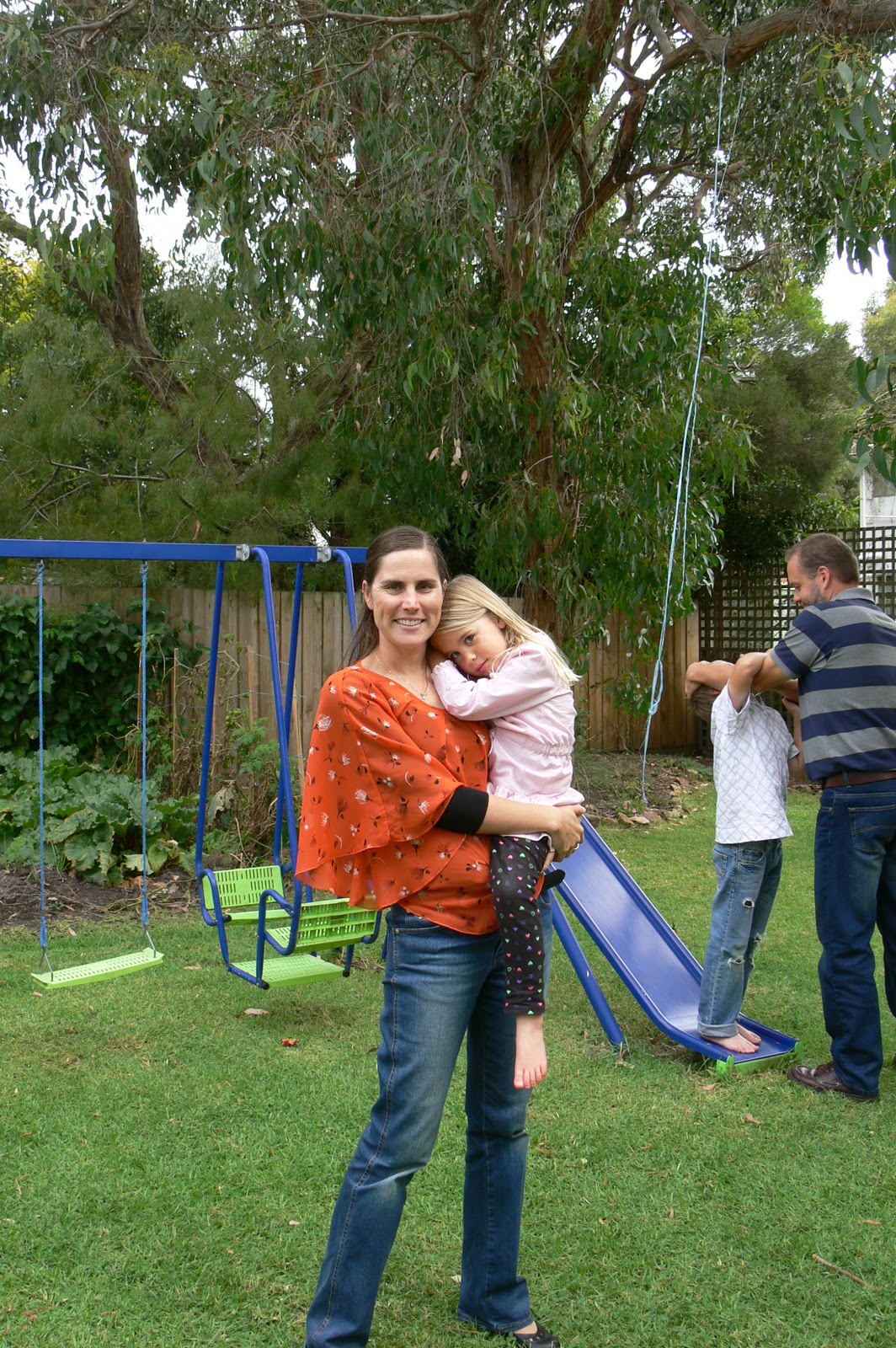
Recently, little miss and padawan spent a day with their Gran and Grandpa.  During that time, little miss found some photos of the gentleman builder and Gran.  As a result, she decided she would like a set of photos of out family where the gentleman builder and I were holding little miss and padawan.
So, we had our sister-in-law take some family photos recently.  We were all dressed up for a family baptism so it was the opportune time to take some photos.


 I love the look on the kids' faces in the photo below.  They didn't believe that I would actually jump into the gentleman builder's arms.

The benefits of La Nina

Wild weather in November

coupled with a wet summer, has meant that our tank is overflowing

The joys of a custom build

There are many people that visit us at the block and they are almost always surprised at the quality of the workmanship.  The gentleman builder and I are amateurs when it comes to building.  I was lucky enough to have a very talented father who endured my 'help' on many home DIY projects over the years.  Being a very patient man, the gentleman builder, like my father before him, endures my 'help' on building the shouse too.
The gentleman builder spends many frustrated hours fixing the 'work' I have done with the best of intentions but that does not come up to his exacting standards.  While I have the enthusiasm, I lack in technique.  I love building and find it very rewarding but I am, alas, not as skilled as my husband or my father.  I have a mean hammer arm and I can render with the best of them but there are many things that I am not so skilled at (skew-nailing and accurate saw work are the first two things come to mind).
Nevertheless, my husband has persevered (perhaps as I work to fund the project; or is that too cynical?) and he has created an incredible purpose-built space that is morphing into a home on an almost daily basis now.
While over Christmas we were dreaming of moving in over Easter, that has not eventuated and there is still a long list of things to do before we can get the building inspector in to sign off on "our" build.
One of the joys of building something yourself, that you have designed and laboured over, is that it becomes an extension of your belief system and values.  As a family, we firmly believe in sustainability.  We love our children and spend a great deal of time with them.  We take pride in the work that we do and make conscious decisions when it comes to things we consider important. 
I love to watch padawan and little miss explore our block and take great pride in the things that they do.  Recently, we rendered the second coat on the south wall and, as a result the tarps on that side of the house came down.  This revealed the view to Corner Inlet from the south-facing window.  The children loved it and asked me to move the table and chairs so they could make use of the wide sills and take in the views.


Also, insects love to be on our house.  We regularly find stick insects on the north wall, sunning themselves and generally being happy.  Last week, I found a grasshopper inside.  Taking time out from the heat, no doubt as it was a particularly warm autumn day.
 To me, this indicates that the house is truly non-toxic.  Insects would not ordinarily choose to make home in something that would cause them damage.  I like that we will be living in a home that is safe.  That will not be off-gassing noxious crap to infect our lungs and cause us distress.  I hope that I will have fewer migraines when we are living in the shouse as I am sure that the fumes from the paint that we used in the house that we are in currently contribute to that particular ailment.

We have one structural and one non-structural wall in the shouse as well as the roof downstairs and in the attic that will be painted.  We have been experimenting with natural casein paints as we cannot afford to buy low VOC paints that are commercially available.

We trialled a number of options, from left to right:
  1. Straight lime putty which has been rejected because it imparts a powdery residue when you rub it
  2. Lime putty with PVA which performed really well but has been rejected because of the smell
  3. Lime putty with PVA and pigment (which we made from crushing some rocks from the driveway) - also rejected due to the smell
  4. Casein paint - recipe needs refining as the batch we made on the test strip below was too watery
  5. Casein paint with pigment - again, the recipe we used for the test strip was too runny
I like the colour of the lime putty and PVA mix but the smell is too offensive in our very inert home.  We're in the process now of trying to perfect a casein paint.