Showing posts with label environmental sustainability. Show all posts

Sunday, 15 July 2012

Natural building products

I've mentioned this before but it continually amazes me how hard it is to source natural building products.  The latest is natural paint.  We have tried making our own casein paint with limited success.  The volumes needed, however, have forced us to seek alternatives.

It's relatively easy to find truly natural, zero VOC (volatile organic compound) paint in the UK.  There's  Earth Born, Bioshield and Ecotec Natural Paint.  But we struggled to find suppliers of these paints in Australia and the weight (and wait) involved in shipping from Europe made them an inviable option.

There's the less natural option of  Volvox that is available in Oz but we were firm on the need for paint with no VOCs so kept looking.

There is method behind the madness.  The high vapor pressure of volatile organic compounds (VOCs) is caused by a low boiling point, which means that large numbers of molecules evaporate and are discharged into the air at ordinary room temperatures.  One VOC in paint is formaldehyde which is colourless but has a pungent, irritating odour and is a known carcinogen (i.e. it causes cancer).  Now, I am not one to look kindly on deliberately installing products in my home that are likely to cause my family ill health.  Ergo, the need to find paint with no VOCs.

So, we continued on our quest and eventually contacted the lovely staff, Hartmut and Elke, from the Natural Paint Company, based in Port Macquarie New South Wales, and managed to purchase some brilliant natural paint and vega primer from them.

The paint that we purchased is casein marble paint, such as was used by the ancient Egyptians in 1300BC.

The vega undercoat dries clear.

The casein marble paint goes on clear

and dries white.

Best of all, there is no smell. 

The paint comes in powder form and is mixed with a drill bit attachment.  The best bit about the paint is that we made an oil-based version for use in the bathroom and on the roof in the kitchen as it is much more water resistant.  To ensure the paint is still white once the oil has been added (we used tung oil but for a cheaper option safflower oil can be used) we purchased some titanium white pigment to include in the oil paint.  For the walls and roof in the bathroom we used about 30% oil.  We plan to make a richer oil-based paint for the windows.


Monday, 9 April 2012

The joys of a custom build

There are many people that visit us at the block and they are almost always surprised at the quality of the workmanship.  The gentleman builder and I are amateurs when it comes to building.  I was lucky enough to have a very talented father who endured my 'help' on many home DIY projects over the years.  Being a very patient man, the gentleman builder, like my father before him, endures my 'help' on building the shouse too.
The gentleman builder spends many frustrated hours fixing the 'work' I have done with the best of intentions but that does not come up to his exacting standards.  While I have the enthusiasm, I lack in technique.  I love building and find it very rewarding but I am, alas, not as skilled as my husband or my father.  I have a mean hammer arm and I can render with the best of them but there are many things that I am not so skilled at (skew-nailing and accurate saw work are the first two things come to mind).
Nevertheless, my husband has persevered (perhaps as I work to fund the project; or is that too cynical?) and he has created an incredible purpose-built space that is morphing into a home on an almost daily basis now.
While over Christmas we were dreaming of moving in over Easter, that has not eventuated and there is still a long list of things to do before we can get the building inspector in to sign off on "our" build.
One of the joys of building something yourself, that you have designed and laboured over, is that it becomes an extension of your belief system and values.  As a family, we firmly believe in sustainability.  We love our children and spend a great deal of time with them.  We take pride in the work that we do and make conscious decisions when it comes to things we consider important. 
I love to watch padawan and little miss explore our block and take great pride in the things that they do.  Recently, we rendered the second coat on the south wall and, as a result the tarps on that side of the house came down.  This revealed the view to Corner Inlet from the south-facing window.  The children loved it and asked me to move the table and chairs so they could make use of the wide sills and take in the views.


Also, insects love to be on our house.  We regularly find stick insects on the north wall, sunning themselves and generally being happy.  Last week, I found a grasshopper inside.  Taking time out from the heat, no doubt as it was a particularly warm autumn day.
 To me, this indicates that the house is truly non-toxic.  Insects would not ordinarily choose to make home in something that would cause them damage.  I like that we will be living in a home that is safe.  That will not be off-gassing noxious crap to infect our lungs and cause us distress.  I hope that I will have fewer migraines when we are living in the shouse as I am sure that the fumes from the paint that we used in the house that we are in currently contribute to that particular ailment.

We have one structural and one non-structural wall in the shouse as well as the roof downstairs and in the attic that will be painted.  We have been experimenting with natural casein paints as we cannot afford to buy low VOC paints that are commercially available.

We trialled a number of options, from left to right:
  1. Straight lime putty which has been rejected because it imparts a powdery residue when you rub it
  2. Lime putty with PVA which performed really well but has been rejected because of the smell
  3. Lime putty with PVA and pigment (which we made from crushing some rocks from the driveway) - also rejected due to the smell
  4. Casein paint - recipe needs refining as the batch we made on the test strip below was too watery
  5. Casein paint with pigment - again, the recipe we used for the test strip was too runny
I like the colour of the lime putty and PVA mix but the smell is too offensive in our very inert home.  We're in the process now of trying to perfect a casein paint.

Rayburn Royale

When designing our home, we incorporated a wood-fired stove.  The main reason was that we figured we have 50 acres and plenty of trees so we would be able to harvest timber from our property in a sustainable way to fuel the stove.  Secondly, we like the idea of slow cooking.  The gentleman builder loves stews and I cannot go past a good soup, especially in autumn.  Those cold days where you cannot justify starting a fire (or turning on the heater) but want something warm and tasty for lunch are perfect soup days, in my opinion.  
Just today, I made a vegetable soup with produce generously given to us by the gentleman builder's mum.  It contained fresh organic carrots, beetroot and zucchini in stock and tinned tomato base.  Delicious!
We had been looking for a second-hand Rayburn Royale for months when the Gentleman Builder came across an ad in The Weekly Times.  I knew straight away that it was the stove for us, even though the ad was generic and did not specify the brand.
The Rayburn Royale is made by AGA and, unlike the AGA, designed for solid fuels.  I had my heart set on a white or cream model but we were getting desperate so was willing to negotiate on that point, if a stove in good condition came along.  We had a firm budget of $3000 including transport.  We had seen plenty of good Rayburns which would have come in at $3200 but we just could not afford to extend beyond the budget.  After the purchase there would be additional costs involved in repairs (inevitable when you move something that weighs 300kg and is probably 50 years old), additional parts (our roof is tall and most second-hand stoves do not come with a flue included), and installation (the water jacket needs to legally be connected by a plumber).
When the gentleman builder called the number in the ad, the news was good.  The price, including transport, would be less than we budgeted and when the photos came through, the stove was white.  We purchased and the sellers very kindly assisted us in getting the stove onto a pallet and to their local depot for collection by the trucking company.  We collected from Stoites in Welshpool where they kindly used a forklift to put it into the trailer and just had to work out how to get it safely off the trailer and into the shouse.
The gentleman builder had prepared well.  He had moved the pile of ironbark beams to fashion a ramp that was the right height for the trailer and we made a monorail to use some metal rollers to get the stove around the north and east sides of the shouse and into the front door.


Padawan and little miss were somewhat excited about the acquisition.

Part of the recycled packaging warned to bend your knees to lift the box with a weight of 10-16kg.  Funny when the stove weighs more than 300kg and with both the gentleman builder and I pushing we could barely move it until it was on rollers.
 The monorail we set up to get the stove from the trailer to the north of the house, around the east side and in through the front door.
The stove has an inbuilt hot water jacket which will boost the solar hot water in winter.  This will be plumbed in when the second fit is done.

The gentleman builder was pretty happy with the condition of the stove.  We're all looking forward to the first roast meal we cook in the 'new' stove.

Interior fit

With the plumbing and electrical phase one complete, the gentleman builder sanded and stained the beams with a mix of linseed and tung oil.  The transformation was a bit Cinderella and we are very happy with the result.


The shower base was installed with cement sheeting and silicone at the joins.

We spent a great deal of time researching insulation.  Ideally we would have loved to have purchased a pure wool insulation.  In the UK you can purchase pure wool insulation, in New Zealand 100% wool that is treated with borax.  In Australia, you cannot get such great products (note to Australian wool growers - there is a potential market here).  So, we settled for Earthwool.  It is made from recycled glass (read, beer bottles) and is lower VOC than any of the other products we looked at.  You still need the full garb of safety gear to cut and install it but it's much less itchy than standard pink batts.


We purchased a second-hand plasterboard lifter and what seemed like an awful lot of pasterboard.


We started with the internal wall. Covering it with plain plasterboard made such a huge difference to the space.

Serious measurements were required to get a close fit around the irregularly shaped beams.
 The result was pretty good!
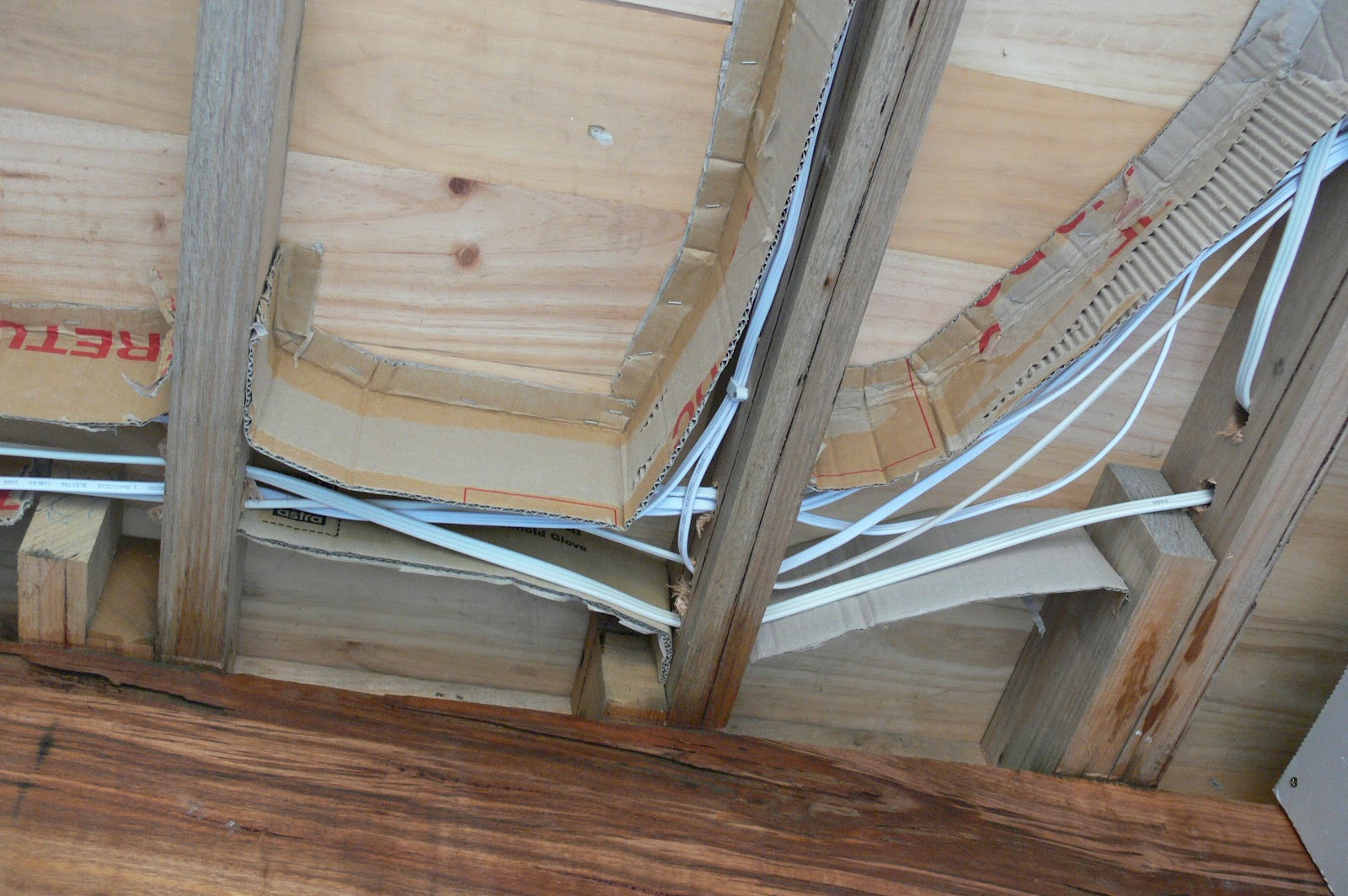
After the insulation dramas the resulted from the Victorian government rebates in 2007, changes were made to the building code which now requires a 5mm air gap between insulation and electrical cables.  To achieve this you can purchase "standard" cardboard separators.  These are available in standard nominal widths to suit common building timbers.  We went for a cheaper option and recycled the cardboard boxes we get when we purchase fruit and vegetables from our local green grocer.

 Again the trusty staple gun earned its place among our most treasured tools.
The Earthwool insulation was cut to length and installed.  Initially we used string to hold it in place but we quickly learned that friction was enough to stop it from falling it we went straight to putting up the plasterboard.


Our joists were not standard spacing throughout the shouse because rather than employ the standard building practice which is to space the joists at 450mm centres and then the last two joists at whatever the leftover is.  Mathematician that the gentleman builder is, worked out how many joists we would need based on 450 centres then divided the space by the number of joists and spaced them evenly.  Thereby, we marked the location of the joists on the beam and the external walls so we could align the screws with the centre of the joists along the plasterboard.  
The external walls, being rendered by hand over strawbales, are far from square.  As a result, we utilised a technique which employs a pencil embedded in a block of wood to mark the wobbly edge of the plasterboard to match the profile of the wall.  A plasterboard saw made pretty easy work of cutting the irregular edge.


Now it is back to rendering the third coat inside before the electrician and plumber come back to install fittings and fixtures.


Saturday, 3 March 2012

Eat food, not too much, mostly plants

Eat food, not too much, mostly plants (Michael Pollan) is one of my favourite quotes.  I love Michael Pollan.  He advocates for eating organic food and supports self-sufficient mixed farms.  Pollan is a regular columnist with the New York Times, was a consultant on the popular food expose, Food Inc. and has written a number of brilliant books.  Pollan intends to provide a framework for simple, healthy, sustainable eating and advises people to consider the food choices they make, opting for ethical eating. 

Lately, I have come across a number of articles backing up my way of thinking about food.  AlterNet recently posting on why we need to radically change the way we eat.  It frightens me that corporations essentially own our food security.  Companies like Monsanto 'own' the genetic makeup of many of the staple foods we eat.  Moreover they create crops that are essentially sterile, thereby forcing people to purchase seeds on an annual basis.

This is the reason I love companies like the Diggers Club that sell open-pollinated heirloom vegetables and are passionate about preserving traditions.  Diggers don't use genetically engineered seeds and oppose the use of chemicals.  

I am convinced that organic food is the only way to eat and, though organic produce deserves a premium, we are not in the position to buy organic.  That, combined with the fact that peak oil is here and we all need to think about food files, is why we intend to grow all our own food.  We have a small vegetable patch at present (see below) which we intend to increase significantly once we are living at the block.

Padawan and Little Miss are very proud of their pumpkin plants
I think that chefs like Stetphanie Alexander and her kitchen garden program, Jamie Oliver's  Ministry of Food, gardeners like Peter Cundall and companies like Little Veggie Patch Co. are doing a great job in trying to open people's eyes to the lies they are being fed, literally, with regard to the food that they eat.

Organic food tastes better than cold-storage mass produced food and has more nutrients.   Home grown organic food is even better.  Not only does home grown organic food have zero food miles; the fact that it is fresh means that it can be picked when ripe rather than picked in time for it to be ripe once it is in the shop and ready for sale.   Ripe food tastes totally different to the second-rate producet that is bought in shops.

I thoroughly endorse farm gate sales of fresh local, seasonal produce.  Admittedly, eating seasonal food takes a little getting used to.  At the moment, zucchinis and tomatoes are in season.  This is brilliant as a side of ratatouille is delicious.  So is zucchini slice.  However, once you have had both of these for four weeks straight, zucchini and tomatoes are not looking so great.  The up side, though, is that when you start to get truly sick of zucchini and tomatoes, pears and pumpkins are ripe and you can then feast on pear tea cake and pumpkin soup just as the days start to get shorter and the nights start to get colder.  My point is, that seasonal produce is just that - seasonal.  It comes and goes.  

Unless of course you preserve the harvest.  By preserving, you can enjoy seasonal produce all year round.  For example, blackberries are generally only in season for 2-6 weeks, depending on the year, they make the most delicious jam, can be frozen or bottled.  Likewise, while apples store pretty well in the right conditions they also stew and bottle well.  

If you are keen on preserving, I can thoroughly recommend Vacola jars.  They come in a variety of sizes and, with new seals, can be used many times over.  If you decide to go down this path, select the stainless steel lids.  They are a little more expensive but won't spoil acidic foods like tomatoes.

If you are time poor or lacking in space and think that you cannot grow your own produce, I urge you to at least plant some herbs in a pot.  Potted gardens can be incredibly productive and fresh herbs add a depth of flavour to food that is hard to beat.  Lettuce is another crop that is easy to grow in a small space.  Container gardening can be very productive and rewarding.  Just remember that if you are growing plants in a container you will be their sole source of nutrients so you will need to routinely add organic fertiliser to ensure optimal growth.  I thoroughly recommend seasol if you are looking for something to fertilise your plants with.

Growing food is such a rewarding pursuit and kids can get involved too.  Perhaps you could get the kids to help out with making icypole stick labels for your plants or let them make a pinwheel to decorate the garden.  Kids love to water plants and watch them grow and small watering cans are inexpensive.  You won't be able to stop them when it's harvest time, either.  My kids refuse to eat spinach unless of course they are picking it from the garden to eat fresh for lunch as a part of a salad they grew themselves!

Tuesday, 21 February 2012

Charcuterie

The gentleman builder is not only a builder, an artist and a bladesmith; he's also a food lover.  He adores fine food - organic spinach with homegrown eggs, 85% cocoa chocolate and fresh meat are high on his list of favourites.

The gentleman builder has great plans for the block in terms of a mixed farm business that will mean that we can get a bit of cash from selling cows, sheep, goats and pigs and, to a certain degree, pick the markets when they are high to sell our produce at a premium. We aim to obtain organic certification for the farm and have not used chemicals since we purchased the property in 2005.  We will have a mixture of poultry too - ducks and chooks are a given and we're still negotiating on geese (I'm happy to have geese as long as they are not kept too close to the house and they're honking and hissing is not at all appealing to me).  In fact, chooks will be first on our list of stock purchases when we move in to the block as the family eats a lot of eggs and there's nothing quite like fresh, organic eggs!

Anyway, back to the story at hand.  The gentleman builder is not a fussy eater (he married one, though) but has a real soft spot for good quality, fresh food.  I bought him a couple of books from the Book Depository at some point about preserving meats as he had spoken at length about his plans to butcher (or have butchered) a portion of our livestock once we're set up for such things so he can have a meat freezer stocked with delicious meaty treats.  Being a vegetarian, I cannot share his enthusiasm for this particular pursuit but I support him in eating quality food that is free from chemicals and, considering our children are also keen carnivores, I think it is a great idea to take advantage of the beautiful meat we will grow.  Organic, grass fed produce is pretty difficult to find and has many health benefits over produce grown on grain.

The gentleman builder sourced some natural casings, purchased some meat and dug out the mincer my Mum had handed down to me.  He then set about making his own sausages.  

Meat


Sausages


Through the process Padawan and Little Miss learnt the value of sausages.  The whole process took over an hour and the sausages lasted about a week, rationed out.  The kids beg the gentleman builder to make sausages on a fairly regular occurrence and whine incessantly when the response is "when we are living at the block we will have more time for things like that again".


Monday, 20 February 2012

The ultimate in sustainable living

I have been heartened today.  One of the few ladies I truly admire and respect, Miranda Kerr, has again come out in support of breastfeeding.  In her blog, Miranda talks frankly about the latest hurdle breastfeeding mums are facing, that of breastfeeding in public.  Having breastfed for nearly 9 years of my life, I can admit to breastfeeding my children in pretty much every place you can imagine - the shopping centre, parked car (picture any place you've seen a car parked and that would have been me), park benches, my bed, the lounge room floor, the swing, atop of a hay bale, on the side of the road, you get the idea.

I received many negative comments along the way.  Initially I took the unlightened and insensitive comments personally and found myself questioning my choices.  Over time and through my involvement as a breastfeeding counsellor with the Australian Breastfeeding Association, I took these encounters as an opportunity to educate people about breastfeeding.  Whenever I received a negative comment about nourishing my child with the best food it will ever receive, I would pick a fact about breastmilk or breastfeeding and state it clearly and plainly.  

For example, when a man in his early 80s once commented on me breastfeeding my then 5 year old son after he had a nasty fall on the street I very calmly responded that the act of breastfeeding releases oxytocin (the "love hormone") in both mother and child and helps to soothe a child after a fright or injury.  When a woman in her late teens snickered at me breastfeeding my baby while pushing the trolley, I turned around and calmly told her that my child was hungry and that she needed a feed and did not have the ability (at 5 weeks) to wait until my grocery shopping was done.  She stopped and we chatted for a few minutes about breastfeeding and both walked away happy.

It took me a long time to master this response but it was well worth it.  

Breastfeeding is the ultimate in sustainability.  There are no bottles, no teats, no sterilising, no washing, no tins, no waste.  Breastmilk is available when needed in whatever amount is required.  It is at the perfect temperature and is, as my husband keeps telling me, served from a much more attractive vessel.  The breastfed child receives the perfect blend of water, long chain fatty acids, immunoglobunlins, protein and carbohydrates. Breastmilk is easily digestible.  Breastfeeding reduces the risks of SIDS, asthma, diabetes, lukemia, breast cancer (in both mother and child), eczema and obesity.   Furthermore, breastfeeding increases intelligence, boosts bonding between mother and child and reduces the production of cortisol (a stress hormone).

Breastmilk changes in composition over time.  Colostrum, the milk produced prior to and for the first three to four days after birth, is rich and high in protein which helps clear the bowels of meconium.  Should a breastfed child get ill, the mother will produce antibodies to help the child fight off the infection.  In hot weather, breastmilk has a higher water content to quench thirst.  As a child weans naturally, breastmilk reverts to consistency similar to colostrum.  A final gift from nature!

Sunday, 19 February 2012

Micro homes - finally I'm trendy!

When we were first designing the house, my hubby kept assuring me that we didn't need a 3 by 4 metre laundry.  I was convinced that having the space to iron and hide the clothes airers in winter was essential.  My hubby tried to assure me that the kids could share a room until they left home.  I was sure that they would eventually need their own space so it was essential to have at least 4 bedrooms (one for guests too).  I also managed to convince him that, to make sure that we could cater for families that may come to visit 5 bedrooms would be required.  As we like to preserve our own produce and plan to be as close to self sufficient as possible on the block a large pantry would be required.  The final house design included a 4x4m walk in pantry behind the kitchen.  The pantry design included an outside door so we could cart firewood directly into the pantry rather than traipse it through the house.  It even had a designated library with walls that would be lined with bookshelves and space for a chesterfield sofa as that had always been my husband's dream.

At the time my husband had tried to tell me that a small home would be cheaper (and easier) to make and that we really didn't need all that indoor space.  I found it hard to see how, with 50 acres, we wouldn't just build what we thought we would need.  My hubby showed me a series of photos of micro homes and the insides of yachts and various other sea-faring vessels in an attempt to convince me that living in a smaller space would really be just fine.   I was sure that we would need each and every part of the above design and could not come to accept any other opinion.


I've already mentioned that the original plan was to build the shouse and live in it while we built the house then convert the shouse to a shed and garage. However, weather and illness delayed the project significantly (by about 3 years) and has meant that the money we had set aside to start building the house with is no longer.  As a result, the shouse will be our final resting place.  It may or may not have an extension built at some later stage (we're still negotiating on that point and the discussions have been put on hold until we are living on site).

The shouse is designed with a bedroom and ensuite, living area (a kitchen, dining and small lounge) and an 'attic' area for storage.  This all fits into a 9 by 6m rectangle (taking account of the 500mm thick strawbale walls).

Since coming to the conclusion that the shouse will be our home for at least a decade, I have realised that we probably don't need a 4x4 metre pantry (the design I have recently come up with will have a pantry that will fit in the 830x1000mm space under the stairs to the attic). I have also realised that we will not need a library.  We have plans to have high shelves between the beams that will store our books (I'll still get my library ladder).  We will made use of vertical space and have floor to roof cupboards in the bedroom and bathroom.  The attic will have a bank of cupboards around the circumference that will store all manner of infrequently used items.  The windows in the bedroom and the dining room have beautiful wide sills that we will be able to use in lieu of window seats.  We imagine that the large sills will come in particularly handy when we have parties.  

The thought of living in small home has had to make us think about the things that we own and start to prioritise what we really want and need.  We are currently in a standard 3 bedroom home and have stuff all over the place in each and every room.  We are planning an enormous cull of possessions when we move into the shouse as there are just so many things in this house that we just don't use.

For example, the 'back room' is chock full of stuff, 99% of which we just never use.  It has all my work clothes (which is the 1% that does get used), a spare bed (used about a dozen times in the last 4 years), an enormous pile of kids toys, some camping mattresses (which have not been used since we moved here as we have not had time for holidays but will hopefully get some use again once we have finished building), the clothes airers which are pulled out in winter, a stack of clothes kindly donated to us from friends and family that don't yet fit the kids and about 5 boxes of things that we brought from Melbourne but have never opened.


While the shouse is a small house it should suffice for the four of us and we like to consider ourselves ahead of the trend as in the last few months we have seen mainstream media reporting on micro-houses. Micro homes are increasingly being considered by individuals, couples and families alike.  Even Oprah has featured the small home movement. Soaring property prices and a realisation by many that more stuff does not necessarily mean more happiness has led to many bucking the McMansion trend and turning to smaller homes.  Tumbleweed seem to be the market leaders in small home designs.

The small house movement is reported more frequently as a viable option for people looking to downsize or for those looking for an ecologically friendly way to live.  Generally speaking, the smaller your home's footprint is the less impact it will have on the environment in terms of building products.  Obviously there are choices you could make that would mean a larger home could be incredibly environmentally sensitive (think composting toilet, sustainably harvested timber, recycled windows, cork flooring etc.).  Likewise, a small home built from steel and concrete could have quite a large environmental impact.

Now, I am all for saving the environment, reducing our ecological footprint, recycling whenever possible and living with less but even I have limits.  I could not personally, for instance, live in 8.3 square metres!